Written by Julius Jürgens
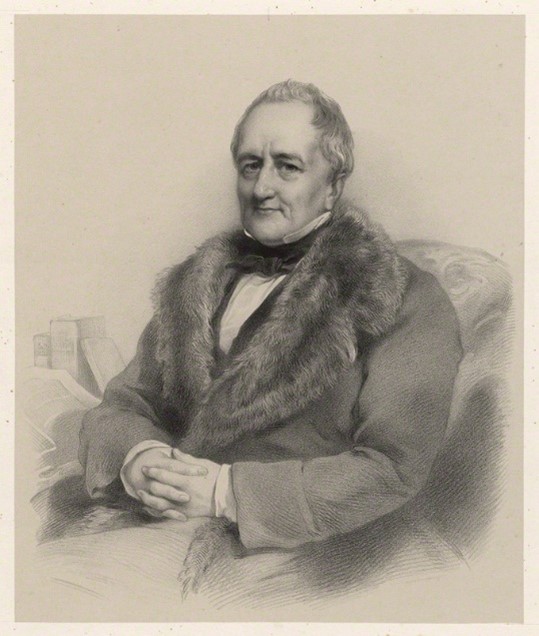
William Richard Hamilton (1777–1859) was a British antiquarian and diplomat (see fig. 1), who is especially known for his supervision of the transport of the Parthenon marbles and the Rosetta stone1 to London. He had been appointed as Secretary to Lord Elgin in 1799.2 In that position, he went on an expedition through Egypt in 1801 and 1802. The campaign started soon after the British army had conquered Alexandria, therefore he was accompanied by British military personnel.3
“The object of our journey was to make a general survey of the country, as well in regard to its military and geographical, as to its political and commercial state, and in particular to collect some accurate details respecting those monuments of the power and grandeur of the antient [sic] Monarchy, which the climate and retired situation of Upper Egypt have left in better preservation than those of any other party of the antient [sic] Roman world.”4
The group used boats called Cangias to ascend the Nile heading south and to access smaller lateral rivers or canals of the Nile.5
From November to December 1801 they stayed in Aswan for three weeks to study remains of the ancient sites of Philae, Elephantine and Syene, as well as the ancient quarries of Syene, the cataracts and the countryside close to the Nubian border.
After reaching the western shore of the Nile next to Elephantine, Hamilton and his companions had walked a mile through the sand dunes and discovered an abandoned Coptic monastery he referred to as “Deir el Garbié”, which “[…] appears to have been once well inhabited and endowed”.6 These ruins are most likely that of Dayr Anba Hadra, also known as the monastery of St. Simeon. In the remains of the building they found a Greek inscription mentioning the Roman emperor Diocletian.7
On the island of Philae, the group noticed a small peripteral temple which had no cella and was therefore considered as unfinished by Hamilton.8 The “Grand Temple at Philae” had “two colossal pyramidal Propyla, one between the Dromos and Pronaos, another between the Pronaos and the Portico, and a smaller one leading into the Sekos or Adytum.”9 Hamilton noted, that none these Proypla had been constructed in an orthogonal layout, but that all had a slight tilt to the East. The entire western side of the complex was standing on massive foundations directly built onto the river bank. Hamilton observed two obelisks – one of them was still standing and had a Greek inscription. It is likely, that this was the “Philae obelisk”, which was brought to Kingston Lacy in 1827.10 Inside the Grand Temple, Hamilton noticed several inscriptions in Latin, Syriac, Armenian, Coptic and Greek.11 Of the latter he copied some (see fig. 2)
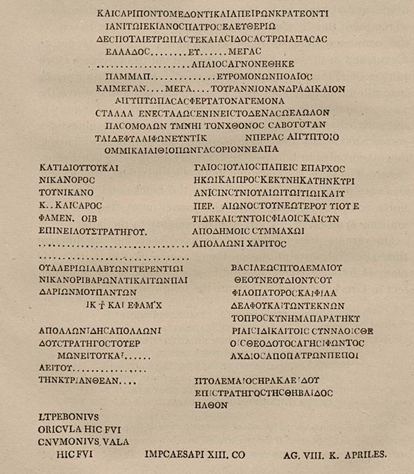
“There are likewise several others in characters of a much later date, with a Greek cross over them, and in all these is repeated the expression ἔπι Θεοδώρȣ τȣ ἐπισκόπȣ.“12 As further evidence for the transformation of the temple into a church he mentioned depictions of the Virgin Mary.13
On the island of Bigeh, located west of Philae, Hamilton saw another temple, two colossal granite statues and “[…] an excellent piece of masonry of later times, being to all appearance an arch belonging to some Greek church or Saracen mosque”.14
During his return from Philae to Aswan, Hamilton found several mummy pits on the eastern bank of the Nile and presumed that this was the necropolis of Philae.15 “In some of the mummies the hair, flesh, and nails are in perfect preservation, though very little bitumen appeared to have been used”, while other pits had been excavated by Hamilton’s team.16
After the group went to Elephantine, Hamilton noticed that the surface of the island was elevated and rocky in the south and low and soiled in the north.17 According to him, ruins from many different eras from Pharaonic to Arabic times were spread across the island.18 At he southern part he observed a group of red granite rocks, which he referred to as the ancient quarries of Elephantine and in the West he had discovered two sarcophagi cut in the granite.19
Close to the temple complex Hamilton perceived a statue of Cnuphis, which had “a crosier or pastoral crook in the left, and a kind of flagellum in the right”20 hand – that according to him Pococke had mistaken as lituus in his earlier travel report.21 While there had been no remains of the large Cnuphis temple, two smaller temples still had been visible, one of them had sculptures made of the same plaster that the walls were covered in.22
The inhabitants of Elephantine and Aswan gave Hamilton and his company small material remains from the Pharaonic and Roman past, such as scarabei, rings and coins.23
The eastern bank of Elephantine had a massive brick wall to protect the island from the Nile’s stream and a stone staircase of 66 steps leading down to the river, as well as some remains of unrecognizable buildings.24
The group had gotten the upperpart of what seemed to be a statue of Osiris with a crosier and a flail in each hand, “much resembling the one still to be seen there, a drawing of which is given in Pococke’s Travels”.25
Interestingly, Hamilton stated that he was not able to identify the “Nilometer of Syene”. There had been three places that he assumed could be the Nilometer: The already mentioned staircase on Elephantine, an inscribed granite rock close to the staircase and a group of circular pits at the southern end of Elephantine. The latter he considered as the most probable place of a Nilometer, although Hamilton had spoken to the local inhabitants, who were convinced that their actual purpose was to store salted fish. Furthermore, he compared these pits to the mummy pits on other parts on Elephantine and Philae.26
At the time of Hamilton’s visit, fishing was one of the main occupations of the inhabitants living close to the cataract. He observed that the fishers used to catch the fishes with spears at the moment they were trapped in small puddles of water created by the cataract rocks when the Nile was low. Afterwards, they were salted and dried in the sun for a month.27
When Hamilton came to Aswan, he observed that the once marvelous metropolis had lost its importance over the years:
“The decline of commercial intercourse between Egypt and Æthiopia has converted the populous city of Es Souan into a mean poor town, subsisting on a scanty portion of cultivable land between the river and the rocks of the Desert: its only external sources of wealth are the petty trade with Ibrim, the annual Caravan from Sennaar, and the resort of the Arabs of the Eastern Desert […]”.28
Nevertheless, Hamilton was excited to see the sheer beauty of the two-mile strip of gardens on the fertile land between the river bank and the surrounding desert. Furthermore, he made a description of landmarks he was able to see while approaching Aswan from the North:
“The approach […] is striking and picturesque: the insulated rocks in the mid stream, the island of Elephantine immediately behind them, the fortunate site of the town on a gentle slope, terminating in a hill, with a small fortress to the East; and to the West the mountains of the Desert, with the tomb of an Arab Shekh on their summit, and a ruined monastery half way down the steep […]”29
As they came closer to the cataracts, Hamilton thought he had reached the southernmost part of ancient Egypt and that the group would enter previously unknown lands if they would be able to pass the cataracts.30
After a meeting with the “Aga of Es Souan”, Hamilton and his companions proceeded with observing the ancient buildings in Aswan. First, they found remains of what he considered as roman bridge that may have connected Aswan and Elephantine, renovated later by the “Saracens”. 31 On the hill he identified the remains of a small fortress which the French under Napoléon Bonaparte had been restored before being recalled to Cairo. Close to this fort, Hamilton and his company found a great amount of Arabic tomb-stones with Cuphic inscriptions.32 As Hamilton was about to take some of them with him, locals told him that they were cursed and when French had tried to build an oven out of the stones, they simply disappeared in one night.33
The remains of an ancient temple west of the hill had already been identified by R. Pococke as the Observatory of Syene.34 In there, Hamilton tried to locate the well that was supposedly – as described in Strabo’s Geographika35 – used to indicate the day of the summer solstice:
“We found indeed a small round stopper within the main chamber, which may have belonged to the hole or well to which Strabo alludes.”36
However, he noted that Aswan no longer was under the Northern Tropic at the time of his visit, and that the well thus would no longer have functioned as an indicator.37
Next to the temple and closer to the river, Hamilton found ruins of a quay decorated with granite columns. He identified this site as the former entrance to Syene, as there was a direct path to the “great street”, which was still visible. He also mentioned, that the “Saracen Town” – built on the site of ancient Syene – was fortified with a wall of unburnt bricks and towers and that many buildings from that era (houses and mosques) were preserved in fine conditions, although not many roofs or decorative ornaments had remained.38 One of the mosques had even an early Islamic tomb that was still being worshipped. Also, the modern cemetery of Aswan was in between the ruins.39
The ancient granite quarries of Syene were “[…] at the foot of the mountains to the East, and some of them […] close to the river.”40 Remains of cravings from the workers and wedges to separate building parts from the stone were visible to Hamilton. Especially an 80-feet long obelisk – which obviously never reached a state of completeness – caught Hamilton’s eye. The same obelisk was noticed by Pococke as well, and can be seen to this day.41 Plenty of other unfinished stone blocks were in that area, too.42
Around the quarries, the roads leading to the shipment points for the stone blocks were still recognizable to the travel group. On one block close to these, Hamilton saw an inscription:
ΣΑΒΙΝΙΑΝΑΣ ΣΕΡΑΠΕΙΩΝ ΟΡΕΟΥ
Afterwards, they met a mason who was carving a block of granite to form a millstone.43
Hamilton had said that Syene was inhabited by very early Christians, probably from the time of emperor Diocletian, so many monasteries existed in the surrounding area and when he and his company came to Aswan, a so-called Christian quarter still was on the hill above the town.44
- A transcription of the Greek text on the Rosetta stone is included in Hamilton’s Aegyptiaca. See Hamilton 1809, 431–433 for the transcription and Hamilton 1809, 434–439 for the translation. ↩
- M. L. Bierbrier, Who was who in Egyptology 4(London 2012) 239f. ↩
- Hamilton 1809, 11. ↩
- Hamilton 1809, 11. ↩
- Hamilton 1809, 12. ↩
- Hamilton 1809, 33f. ↩
- Hamilton 1809, 34. For the mention of Diocletian in this inscription see the explanation in L. Krastel, ‚Gedenke meiner‘! Die koptischen epigraphischen Zeugnisse des Deir Anba Hadra bei Assuan (Diss.). ↩
- Hamilton 1809, 45. ↩
- Hamilton 1809, 46. ↩
- <https://www.nationaltrustcollections.org.uk/object/1257614.1> (Accessed 15.08.2022) ↩
- E. Bernand, Les inscriptions grecques et latines de Philae 2. Haut e Bas Empire (Paris 1969). Philae 55 (https://inscriptions.packhum.org/text/219554), Philae 63 (https://inscriptions.packhum.org/text/219562), Philae 135 (https://inscriptions.packhum.org/text/219635), Philae 136 (https://inscriptions.packhum.org/text/219636), Philae 142 (https://inscriptions.packhum.org/text/219642), Philae 143 (https://inscriptions.packhum.org/text/219643), Philae 147 (https://inscriptions.packhum.org/text/219647), Philae 151 (https://inscriptions.packhum.org/text/219651). ↩
- Hamilton 1809, 53. ↩
- Hamilton 1809, 53. ↩
- Hamilton 1809, 54. ↩
- Hamilton 1809, 54f. ↩
- Hamilton 1809, 55. ↩
- Hamilton 1809, 55. ↩
- Hamilton 1809, 56. ↩
- Hamilton 1809, 56. ↩
- Hamilton 1809, 56. ↩
- Pococke 1743, 117. ↩
- Hamilton 1809, 57. ↩
- Hamilton 1809, 57. ↩
- Hamilton 1809, 56. ↩
- Hamilton 1809, 57; Pococke 1743, Pl. XLVIII. ↩
- Hamilton 1809, 62f. ↩
- Hamilton 1809, 63. ↩
- Hamilton 1809, 63. ↩
- Hamilton 1809, 64. ↩
- Hamilton 1809, 64. ↩
- For the identification of this building see H. Jaritz, Die Kirche des Heiligen Psoti vor der Stadtmauer von Assuan, in: M. Mukhtar – P. Posener-Kriéger (Eds.), Mélanges Gamal Eddin Mokhtar 2 (Cairo 1985) 1–19. ↩
- Hamilton 1809, 65. ↩
- Hamilton 1809, 66. ↩
- Pococke 1743, 117. ↩
- Str. XVII 1.48. ↩
- Hamilton 1809, 66. ↩
- Hamilton 1809, 67. ↩
- Hamilton 1809, 67. ↩
- Hamilton 1809, 68. ↩
- Hamilton 1809, 69. ↩
- Pococke 1743, 117. ↩
- Hamilton 1809, 69. ↩
- Hamilton 1809, 69. ↩
- Hamilton 1809, 71f. ↩