Written by Fabio Calo
Biography
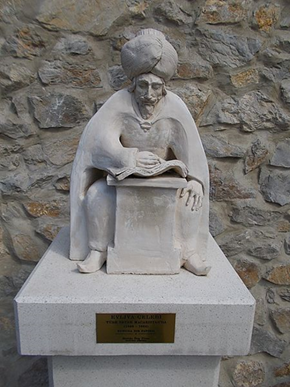
Çelebi was an Ottoman officer, writer, but first and foremost traveller of the 17th century. He was born on the 10th Muḥarram 1020/25th March 1611 in Istanbul as the son of Derviş Mehmed Zilli, who was chief jeweller at the Sultan’s court, and an Abkhazian slave woman.1 Through his mother, he was related to Melek Ahmed Pasha, who was a high courtier at the Port and even briefly held the position of grand vizier in 1060-1061/1650-1651.2 This opened Evliya the doors to a refined education.3 Çelebi received a thorough education in several disciplines; he particularly exceeded in music and Quran recitation. It was especially his pleasant voice while reciting the Quran, which gained him the attention of Sultan Murad IV, who soon let him in to the highest circles of the Seraglio and made him his companion (muṣaḥib).4 His closeness to the Sultan and his affiliation with Melek Pasha as well as his education and his talent as a reciter and narrator also offered him opportunities for higher office.5
Serving in multiple capacities to regional governors and emissaries of the Port, Evliya embarked on a series of travels that would lead him to various places within and outside the Ottoman Empire.6 He published his experiences in his Seyāḥatnāme – ‘Book of Travels’ – which Dankoff calls the “longest and fullest travel account in Islamic literature – perhaps in world literature.”7 In the tenth and last volume of this work, Çelebi narrates his travels along the Nile in Egypt and the Sudan, which he undertook in 1082/1672 and 1083/1673. During this journey, he also made station at Aswan.
Seyāḥatnāme: ‘Book of Travels’
This source requires particular caution because the tradition especially of its later volumes is somewhat precarious.8 In addition, critical editions and translations of the Seyāḥatnāme seem to proceed at a slow pace: While Mordtmann and Duda in 1965 stated that “A critical scholarly edition of the complete Seyāḥatnāme, in the original Arabic script, of course, is an urgent necessity,”9 Dankoff and Tezcan still in 2015 wrote that “only in recent years [had] there been attempts to publish critical editions of the work.”10
Regarding the reliability of Çelebi’s reports, we are also presented with difficulties. Generally, scholars think that Evliya has not actually visited all the stations he wrote about in his book.11
Two (incomplete) translations of Evliya’s journey along the Nile were available for this article: one in German by Prokosch (1994) and one in English by Dankoff, Tezcan, and Sheridan (2018).12 In the following, the English edition will be primarily cited; the German translation will be used when the relevant section is missing in the edition of Dankoff, Tezcan, and Sheridan; when the translations of the two editions differ significantly, both will be given.
Çelebi at İsvan/Aswan
Because Çelebi’s account of Aswan is rather lengthy, for the purpose of this article, it will be devided into the following subjects:
Geography and Textual Problems
Archaeology and Mythology
Cityscape, Economy, and Population
Aswan Castle
- See v. Hammer (ed.) 2012, iii; Dankoff 1991, 3; Prokosch 1994, 9; Dankoff, Encyclopaedia, no page ref.; Mordtmann, Duda, Encyclopaedia, no page ref. His father is also told to have been a standard-bearer to Sultan Suleiman the Magnificent, his grandfather to have been standard-bearer to Sultan Mehmed II at the conquest of Constantinople: see v. Hammer (ed.) 2012, iii. ↩
- The two were cousins (see Mordtmann, Duda, Ecyclopaedia; Dankoff 1991, 3) and have been introduced together as children to Sultan Ahmed. The boy then was given the surname Melek, “angel”, (wether he was also given the name of the Sultan at this occasion or wether the identity of names was coincidental is not clear) and entered into the service as a page of the Sultan. From there he made a career as an officer at the Port. The girl was, according to this narrative, given to the chief goldsmith Derviş Mehmed Zilli – Evliya’s father. See v. Hammer (ed.) 2012, iii-iv; Dankoff 1991, 3. For the prospects of slave boys for high military or political office see Dankoff 1991, 3; Peirce 2021, 6; 8-9; 69-70. ↩
- In fact, his very name refers to his education: ‘çelebi’ is a term for an educated urban gentleman: see Dankoff 1991, 3; Prokosch 1994, 9. This is the name in which he styled himself as a writer; his actual personal name is unkown: see Mordtmann, Duda, Encyclopaedia. ↩
- See Dankoff 1991, 3-4. ↩
- See Mordtmann, Duda, Encyclopaedia, no page ref. ↩
- See Dankoff 2006, 2. ↩
- Dankoff 2006, 9. ↩
- The original manuscript of the Seyāḥatnāme had long been in Cairo, from where it was transferred to Istanbul in 1742, where it was copied, studied and published “haphazardly” between 1896 and 1938 (see Dankoff, Tezcan 2015, 1). The autograph manuscripts for the tenth book are now lost and there is some debate among scholars about which series of manuscripts are to be considered the most authentic traditions (see Dankoff, Tezcan 2015, 2-6). ↩
- Mordtmann, Duda, Encyclopaedia, no page ref. ↩
- Dankoff, Tezcan 2015, 1. ↩
- See Mordtmann, Duda, Encyclopaedia, no page ref. With regard to Egypt, Kornkrumpf has investigated the historicity of his trip to El Qoseir. He arrived at the conclusion, that Evliya was probably not actually there, since the time in which he tells us he made the trip from Qena to Qoseir cannot be true and all the information he gives about this city he could easily have gathered from elsewhere, and goes on to say that “Bei gründlicher Durchsicht seines Werkes wird man leicht noch viele kleinere oder größere Flunkereien aufdecken können, ohne gängige Übertreibungen bei Zahlenangaben zu überbewerten und ohne daß deshalb der Reisebericht insgesamt seine Bedeutung verliert” (Kornkrumpf 2004, 174 and passim). ↩
- For the reasons of their respective incompleteness see Prokosch 1994, 10-1; Dankoff, Tezcan, Sheridan 2018, xii. ↩