Written by Fabio Calo
Biography
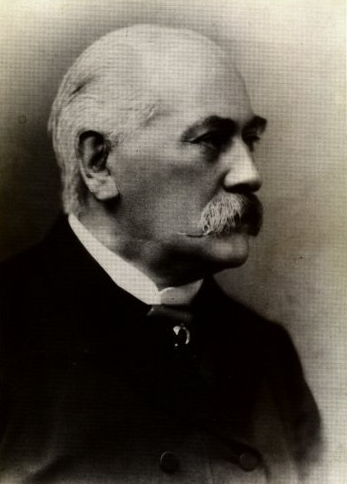
Heinrich Ferdinand Karl Brugsch was a Prussian Egyptologist who was born on the 18th of February 1827 in Berlin and lived until the 9th of September 1894.1 Starting as a pioneer in the studies of the Demotic language, he would later on become an important contributor to the then newly forming Egyptologist discipline.2
In 1853-4, he travelled to Egypt and explored the country along the Nile. This journey led him as far south as the First Cataract.3 In Egypt, he became close friends with French Egyptologist Auguste Mariette who had previously rediscovered the Serapeum of Saqqara.4 He visited Egypt many more times later on in his life,5 but it is mainly his impressions from his first visit in 1853-4, published in 1855, which give an interesting account of what he found at Aswan and in the First Cataract area.
Brugsch in Aswan
Brugsch arrived at Aswan on the evening of the 29th of November 1853. This city, he notes, must have held particular importance in ancient times, as its location was marking a natural border between Egypt and Nubia.6 Shortly upon arrival, he was curious to travel the cataract by boat. He did so with a young French traveller, a Mr. Bardoin, whom he had met in Luxor.7 They began their boat ride at the island of Philae, to which they travelled by land, herein following the geographer Strabo.8 On this way, they crossed a monument of more recent origin:
“Der letztere Weg nach Philä […] führt zunächst über einen Muslimen-Kirchhof, der mit Moscheen, Grabkapellen und Steinen mit kufischen Schriftzügen aus den ersten Zeiten der Hegira reichlich bedeckt ist.”9
The mentioning of mosques and burial chapels in the plural is somewhat curious, as it would be unusual for a regular cemetery to contain several of them. It is possible that what Brugsch is referring to is the so-called ‘Fatimid Cemetery’,10 but with further detail missing on Brugsch’s part, we cannot be sure.
Brugsch also noted dedicatory inscriptions on the walls and cliffs alongside the road, which were made in honour of the deities of the cataract. Most of them appear to have been from pharaonic times, but Brugsch also saw some Roman dedications with latinised denominations for the local deities:
“Eine grosse Zahl von Weihinschriften an Felswänden und Klippen beweisen, dass Wanderer und Fürsten am Hofe der Pharaonen hier den Katarakten-Göttern Num-Ra, den eine lateinische Inschrift Jupiter Hammon Cenubis nennt, der Sati (Juno) und der Anke ihre Verehrung bezeugt haben.”11
After a turbulent crossing through the cataract by boat – Brugsch had his eyes closed during the ride12 –, he turned to the island of Philae, where he resided from the 5th of December onward.13 On the island, he visited monuments which belonged to all the different phases of the island’s history:
“Neben- und hintereinander wohnten hier Aegypter, Aethiopier, Griechen, Römer, Kopten und Araber, und jede dieser Nationen hat ihre Denkmäler aufzuweisen.”14
It is regrettable that he does not go into further detail about these later monuments, especially from Coptic and Arab times, since he would have had the opportunity to see many of those objects which have since been lost to us. Because these objects were just not considered worthy of rescue alongside the more ancient relics, they remained on the island and fell victim to its flooding following the completion of the Aswan Low Dam in 1902. Brugsch at least gives a rough account of the abundance of inscriptions from different times:
“Zahllos ist die Masse von Inschriften, welche sich, die hieroglyphischen ausgenommen, an allen Theilen der beschriebenen Monumente angeschrieben und angekritzelt vorfinden. Da ist hieratische und ägyptisch-demotische, hier äthiopisch-demotische Schrift, da griechische und lateinische, dort wieder koptische Inschriften.”15
He notes that the cult of Isis remained vivid on this island well into Christian times. For this, he mentions as evidence a Greek inscription in the Osiris chamber on the temple’s roof testifying to the existence of a sacerdotal college of this goddess as late as 453 CE.16 Nonetheless, Brugsch found many of the mythological depictions still spoiled on account of later religious rigor:
“Der Eingang von der Säulenhalle aus, welche übrigens oftmals mit dem Namen des römischen Imperatoren Tiberius geschmückt ist, führt den Wanderer zu vier Gemächern, deren reiche Darstellungen fast sämmtlich durch den schlammigen Erdüberzug verunstaltet sind, mit welchem die Kopten die heidnischen Bilder beseitigen wollten.”17
Those mud coatings where applied, so he tells us, when the Christian Nubians put the hitherto pagan temples to a more pious use as their new churches.18 The remnants of the pagan cults could also be seen on newly built Christian churches:
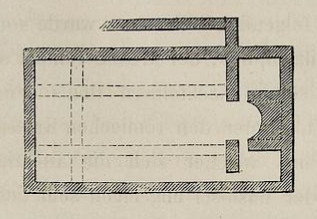
“Später hat man auf dem Nordostende der Insel, nicht weit von dem römischen Thore, aus den Trümmern eines Isistempels mit Schildern römischer Autokratoren und inmitten der Stadt Philä, deren Trümmer noch den alten Plan angeben lassen, eine koptische Kirche erbaut […].”19
Brugsch also provides a sketch of this church’s layout (see fig. 2).
He departed from Philae on the 14th of December and continued his journey, now back down the Nile.20
- For the biographical data see Bissing 1955. ↩
- See Erman 1894, 71. He developed a fascination with ancient Egypt at the early age of twelve years, when he visited the Ägyptische Sammlung at Monbijou Palace in Berlin. His frequent visits would soon invoke the interest of its director, Italian collector Giuseppe Passalacqua (see Brugsch 1894, 28; Gertzen 2013, 72). But young Brugsch did not just look at the exhibits there: at the age of 16, he had already deciphered the Demotic language and grammar and comprised a treatise about it in Latin (see Brugsch 1894, 40-1; Erman 1894, 70; Gertzen 2013, 72). This left a marked impression on Passalacqua, who encouraged him to write to King Frederick William IV of Prussia with the request to fund him the acquisition of an orientalist library. His Demotic grammar bearing the title Scriptura Aegyptiorum demotica ex papyris et inscriptionibus explanata scripsit Henricus Brugsch discipulus primae classis Gymnasii realis quod Berolini floret was published a few years later in 1848 with the aid of Alexander von Humboldt (see Erman 1894, 70; Naville 1903, no page ref.). In the following years, he established himself as an authority in the Demotic field with multiple publications, e.g. the Numerorum demoticorum doctrina (1849), the Sammlung demotischer Urkunden (1850), and the Grammaire démotique (1855). ↩
- See Bissing 1955, no page ref. ↩
- See Naville 1903, no page ref.; Gertzen 2013, 73. Their close friendship lasted until Mariette’s death in 1881 and remained intact even during the Franco-German War of 1870-1, in which both their sons fought on opposite sides (see Brugsch 1894, iii). ↩
- See Bissing 1955, no page ref.; Naville 1903, no page ref. In 1868, he moved to Cairo to found an école d’ Egyptologie at the invitation of Khedive (viceroy) Isma’il Pasha (despite having just assumed a professorship at the University of Göttingen). Even though this assignment came to a halt in 1879 due to financial difficulties and the deposition of Isma’il Pasha, his connection to Egypt was recognized in 1881 with the bestowal of the Pasha title to Brugsch by Khedive Tewfik Pasha (see Bissing 1955, no page ref.). ↩
- See Brugsch 1855, 247-8. ↩
- See Brugsch 1855, 248. ↩
- See Brugsch 1855, 248; cf. Str. XVII 1.50. ↩
- Brugsch 1855, 248. ↩
- This archeological complex has recently been treated by Nogara, Speiser (eds.) 2021. If Brugsch was indeed crossing the ‘Fatimide Cemetery’, he would have had the opportunity to see many objects in situ which have subsequently been dislocated and scattered to museums mainly across Egypt. ↩
- Brugsch 1855, 249. ↩
- See Brugsch 1855, 253. ↩
- See Brugsch 1855, 254. He moved into quarters on his boat on the eastern side of the island between the so-called kiosk of Nectanebo’s temple and the triumphal arch from Diocletian times. The terrace in front of this Roman monument was also his favourite spot to spend his hours of leisure. ↩
- Brugsch 1855, 252. ↩
- Brugsch 1855, 266. ↩
- See Brugsch 1855, 267. It seems likely that he is referring to I.Philae 197, which is dated to the 20th of December 452, and just got the date slightly wrong. On this inscription see Dijkstra 2008, 197-200. For the closure of this temple in late antiquity, see Dijkstra 2008. ↩
- Brugsch 1855, 262. In each of these four chambers, the birth of the god Horus by the goddess Isis is illustrated, as well as his upbringing and education. There are several deities depicted, such as Amun-Ra, who gives to Horus the celestial life, and Thot, who gives him the “Zeichen des Geistes” at birth. The goddesses Neben and Set are representing the South and the North at this divine event and the gods Hu and Sah are there to bring him the senses of taste and of smell. In another scene, Brugsch could see Isis: “Sie heisst dabei ‚Isis die grosse Mutter, die Herrin der Geburtskammer, die vielnamige (âsch ran) — ‚welche säugt ihren Sohn Horus mit einem reinen Leben‘” (Brugsch 1855, 262, italics in the original). There are other deities present, such as Hathor, Nebthi, Thot again, Ptah and Pakhet. See Brugsch 1855, 262-4. ↩
- See Brugsch 1855, 267. ↩
- Brugsch 1855, 268. ↩
- See Brugsch 1855, 274. ↩