Written by Fabio Calo
Biography
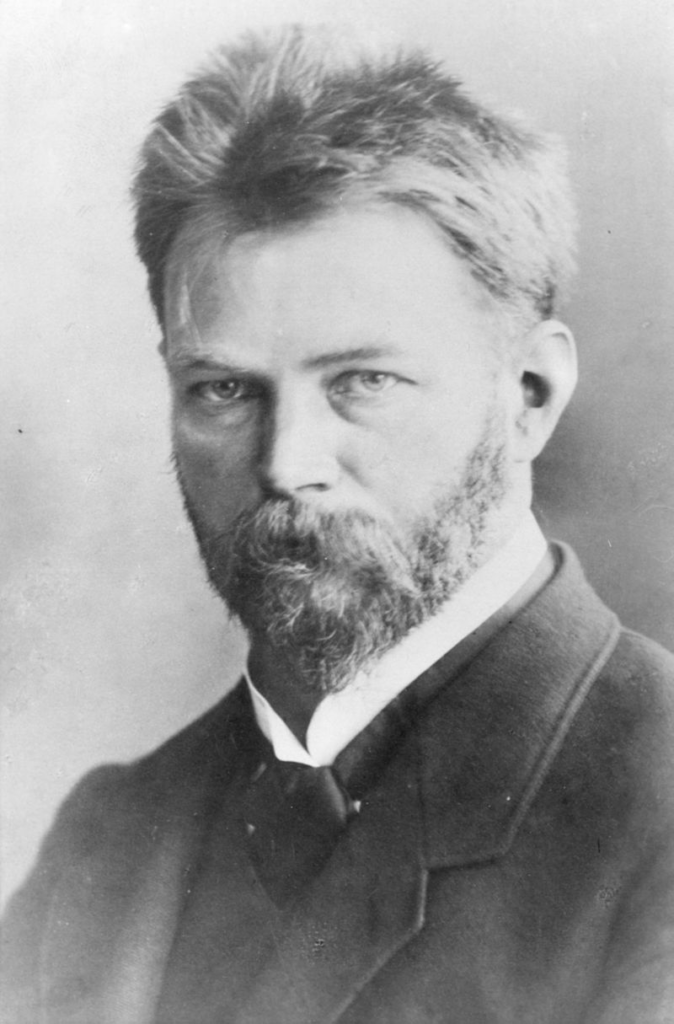
Hermann Thiersch was a German archaeologist of the late 19th and early 20th century. He was born in Munich on the 12th of January 1874.1 After studying Classical Archaeology in Munich and Berlin, he received his doctorate in 1898 with a study on Thyrrenian amphorae and habilitated in Munich in 1904 with a study on “Zwei antike Grabanlagen bei Alexandria.” He subsequently held professorships in Freiburg and Göttingen. He spent many of his active years travelling around the Mediterranean participating in several excavations (e.g. in Greece, Turkey, Palestine, and Egypt). In 1937, while in Greece, Thiersch fell chronically ill and did not teach again until his official retirement in January 1939. Several months earlier, he had been forced to resign from his position at the Akademie der Wissenschaften in Göttingen due to the ‘Nuremberg Laws’ of 1938: according to these laws, his wife Adelheid Thiersch (born Eller) was considered a ‘Halbjüdin’, and Thiersch himself as ‘jüdisch versippt.’ Hermann Thiersch died in Göttingen on the 5th of June 1939.2
Thiersch in Aswan
His first journey to Egypt took place in the winter of 1899/1900. For this occasion, he had been commissioned by the universities of Basel, Strasbourg, and Munich to acquire various papyri, which were in high demand at that time as markers of status in the competition for cultural and scientific hegemony among the European societies.3 During this stay, he headed his first excavations in the necropolis of Alexandria and Abusir, before he joined Georg Steindorff’s Nubian expedition along the Nile from Aswan to the Second Cataract region and back. In addition to Steindorff, his travel group included Heinrich Schäfer, Ludwig Borchardt, and Curt von Grünau.4 On his journey, Thiersch kept a diary, which is among his legacy in the Bayerische Staatsbibliothek in Munich, as well as a sketchbook and a collection of photographs from that journey. This diary has recently been edited and published by Sabine Huebner5 and contains some entries about Aswan and the First Cataract area.
Thiersch reached Aswan by train on the 4th of March 1900, from where they were to travel up the Nile through Nubia by boat.6 The first night the boat anchored directly beneath ‘Trajan’s Kiosk’ at Philae.7 The Aswan Low Dam was at this time still under construction8 and the old island was not yet flooded. Thiersch was, however, well aware of the repercussions this project would have:
“Es ist der Staudamm, de[r] Philae und andre Tempel oberhalb zu Fall bringen wird.”9
But for now, the island was still accessible and the monuments still in situ, so when the absence of the north wind delayed their departure, the group of travellers took the opportunity to visit Philae. Thiersch was pleased to encounter classical monuments as this corresponded to his main interest as a classical archaeologist:
“herrlich. ringsum ödes Steinchaos. der grosse Isistempel eigentlich noch ganz beisammen. und alles erst hellenistische und römische Zeit! wir sitzen oben auf den Pylonen. wieder christliche Kirche in den Tempel selbst eingebaut.”10
Thiersch must have seen some churches that are now permanently lost to the floods of Lake Nasser since most of the Christian monuments were not part of the temple rescue project of 1970s.11
A sudden rise of the north wind called them to their boat just as they were about to sail to Bigge Island and effected their immediate departure. On their first day’s journey, Thiersch remarked:
“zwei interessant gelegene Moscheen: El Bab u. Billal.”12
On their way back, they travelled the last bit from Shellal to Aswan on land by donkeys. Shortly before they reached Aswan on the 18th of April, they passed through a “stiller alter arabischer Friedhof mit vielen zerfallenen Grabbauten, in der Tiefe dahinter liegt Assuan.”13
His last day in Aswan, he spent ‘in a quiet manner’ (“Abschlusstag ruhiger Art”):14
“Bei der neuen festungsartigen Kirche 3 lateinische Inschriften von den Sockeln römischer Kaiserstatuen copiert.15 Dann mit Steindorff und Schäfer noch zu den Granitsteinbrüchen galoppiert am Bischarilager vorbei. […] Nach der Mittagsruhe nach dem nahen Elefantine übergesetzt. Nilmesser. Gräberfeld von den Sebachins aufgewühlt, überall interessante Scherben. Ein demotisches Ostrakon gefunden u. Steindorff gegeben. Mit Schäfer weiter zu den Felsgräbern übergesetzt. Sie liegen am steilen Westabhang, hoch oben, vielfach später von Mönchen bewohnt und beschädigt.”16
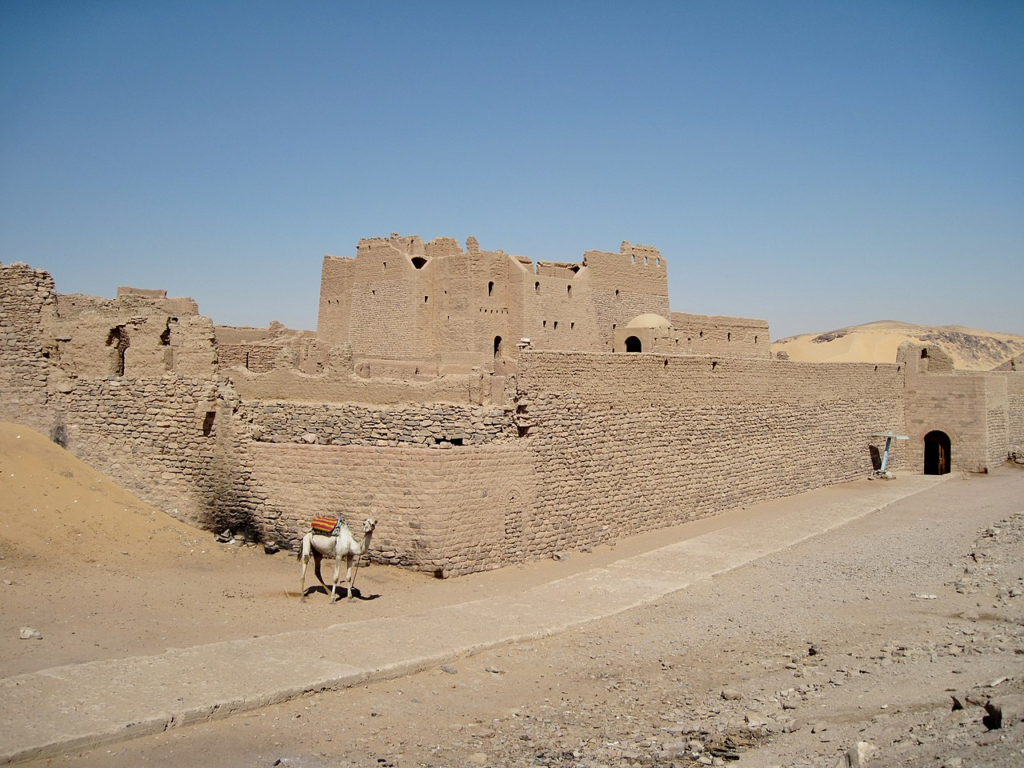
Very early the next morning, before they left Aswan by train, they visited the Deir Anba Hadra, a Coptic monastery in the west of Aswan, which he calls by the name of “Simeonskloster” – a then widely-used designation that has since fallen out of use. The period in which it was being frequented has been dated between roughly the 7th and the 14th century,17 recent studies now indicate that it had not been used as a monastery after the 12th century.18 In 1900, Thiersch resumes:
“Festungsartiges Viereck mit Thoren interessante Absismalerei [sic!]. Besonders gut in den Farben und im Decorativen. eine Felskapelle tief unten. In den Gängen des 2. Stockwerkes des Refectoriums ein weisser Geier in seinem Nest. Im langen Refectorium wie in den Zellen noch alle Gewölbe erhalten. 6-8 Betten in einer Zelle. Treppe bis ins 2. Stockwerk erhalten. Es soll das grösste aller erhaltenen ägypt. Klöster sein.”19
He then took the train to Kom Ombo and travelled back north.
- He was the son of August Thiersch, an architect and professor for architectural history at the Technische Hochschule München, and the great-grandson of Friedrich Thiersch, a philologist and “Philhellene”: see Fittschen 1988, 183. For biographical information about Thiersch see Fittschen 1988; Huebner 2021, 15-6. ↩
- See Fitschen 1988, 184. ↩
- See Huebner 2019, 29; 38; 39; and passim; Huebner 2021, 16-9. He succeded in his task despite speaking virtually no Arabic. ↩
- See Huebner 2019, 30. ↩
- I.e. Huebner 2021. ↩
- See Huebner 2021, 35: “das Schiff gehört dem reichsten Mann in Assuan, einem Zimmermann, der nicht einmal auf einen Contract sich einlässt.” ↩
- See Huebner 2021, 35. ↩
- Thiersch seems to have whitnessed the blastings at the construction sites: see Huebner 2021, 124. ↩
- Huebner 2021, 124. ↩
- Huebner 2021, 36. This is, as Huebner notes (2021, 36 n. 64) one of the several churches that had been built within the ancient temple complex in Late Antiquity. The Isis temple itself had been rededicated as a church of St. Stephen some time ca. 353-7 CE, which is commemorated by five Greek inscriptions, carved into the walls on different parts of the temple: see FHN III 324; Moawad 2013, 32. On the six or seven (depending on the counting-in or counting-out of the Imhotep temple), see Moawad 2013, 32-4. On the practice of ‘temple conversion’ in Egypt and the Syene area see Dijkstra 2008, 85-122. ↩
- See Moawad 2013, 32. ↩
- Huebner 2021, 36. ↩
- Huebner 2021, 124. Huebner identifies this cemetery with a burial site which is described in Baedeker 1897, 338-339: “Die Gräber bestehen aus Rechtecken, die mit unbehauenen Steinen umlegt und mit beschriebenen Steinplatten geschmückt sind. Die ältesten Grabsteine (die meisten davon sind jetzt in das Museum von Gîze gebracht) tragen die altertümlichen Zeichen der kufischen Schrift und entstammen dem IX. und X. Jahrhundert n. Chr. Wenige sind älter, viele jünger. Gewöhnlich lehren die Inschriften, wie der Verstorbene hiess und wann er heimgegangen sei. Die Reicheren ruhen unter kleinen Bauten mit kuppelförmiger Bedachung. Auf der Höhe der Hügel rechts vom Wege erheben sich grosse moscheenartige Kenotaphien, die leeren Gräber berühmter Heiligen: des Schêkh Mahmûd, des Schekh ʿAli, unserer Frau (Seiyidne) Zênab etc., deren Geburtstage (môlid) hier gefeiert werden und deren Andenken man auch sonst Verehrung zollt” (see Huebner 2021, 124 n. 279, italics in the original). ↩
- Huebner 2021, 127. ↩
- Thiersch also made sketches of those inscriptions, which are now with his legacy in the Bayerische Staatsbibliothek in Munich (see Huebner 2021, 127 n. 290). ↩
- Huebner 2021, 127. ↩
- See Olschok 2022, 13 and passim; Bodenstein 2019; see also the bibliographical overview on this website: https://firstcataract.hcommons-staging.org/anba-hadra/. ↩
- See Krastel 2023. ↩
- Huebner 2021, 129. ↩