Written by Julia Schulz
Biography
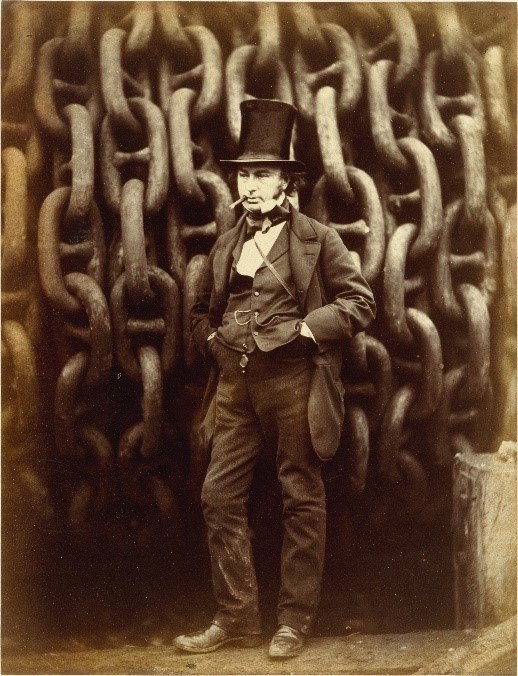
Isambard Kingdom Brunel (see fig. 1) was one of the most renowned British engineers of the 19th century. He was born on April 9, 1806, in Portsmouth, England.1 His father, Marc Isambard Brunel, was also a great engineer of the Industrial Revolution and famous for his design of the Thames Tunnel.2
Under the authority of Isambard Kingdom Brunel 25 railway lines were built, over a hundred bridges3, eight pier and dock systems, three ships4 and a pre-fabricated army field hospital. In 1833, Brunel was appointed chief engineer of the Great Western Railway.5 He died on September 15, 1859, after a prolonged illness which was also the reason for his stay in Egypt during the winter of 1858.6 His journey was being described in the biography that Isambard Brunel Junior published about the life and works of his father in 1870.7
Brunel’s Stay in Egypt
The engineer together with his wife and son left for Alexandria at the beginning of December 1858, spending Christmas in Cairo before continuing their journey up the Nile. Brunel Jr. writes how they “reached Assouan on February 2, and made preparations for ascending the cataracts. They8 went as far as Dakkeh, and got back to Assouan on February 19.”9 The report also included a letter Isambard Kingdom Brunel wrote to his sister from Philae on February 12, 1859:
“Approaching Assouan, you glide through a reef of rocks, large boulders of granite polished by the action of the water charged with sand. You arrive at a charming bay or lake of perfectly still water and studded with those singular jet-black or red-rock islands.”10
Brunel was fascinated by the currents of the First Cataract. So much even that he decided to journey to Philae by boat after he had already visited the island by land:
“After spending a week at Assouan, with a trip by land to Philae, I was so charmed with the appearance of the Cataracts as seen from the shore, and with the deliciously quiet repose of Philae, that I determined to get a boat, and sleep a few nights there. We succeeded in hiring a country boat laden with dates, and emptied her, and fitted up her three cabins. We put our cook and dragoman and provisions, &c., on board, and some men, and went up the Cataract.”11
Brunel is one of the few visitors to Aswan who can say of himself to have experienced the rapids. He went into detail about them and gave technical comments on navigating the waters at the First Cataract:
“It is a long rapid of three miles, and perhaps one mile wide, full of rocky islands and isolated rocks. A bird’s-eye view hardly shows a free passage, and some of the more rapid falls are between rocks not forty feet wide – in appearance not twenty. Although they do not drag the boats up perpendicular falls of three or four feet, as the travellers’ books tell you, they really do drag the boats up rushes of water which, until I had seen it, and had then calculated the power required, I should imprudently have said could not be effected [sic]… We were probably twenty or thirty minutes getting up this one, sometimes bumping hard on one rock, sometimes on another, and jammed hard first on one side and then on the other, the boat all the time on the fall with ropes all strained, sometimes going up a foot or two, sometimes losing it, till at least we crept to the top, and sailed quietly on in a perfectly smooth lake. These efforts up the different falls had been going on for nearly eight hours, and the relief from noise was delicious. We selected a quiet spot under the temples of Philae.”12
- Brunel 1870, 1. ↩
- See <https://designmuseum.org/designers/isambard-kingdom-brunel> (Accessed 16.03.2022). For further information on the history and construction of the Thames Tunnel see Brunel, I., “The life of Isambard Kingdom Brunel, civil engineer” (London 1870) 6-39. ↩
- Like the famous Royal Albert on the Cornwall Railway, which was designed to cross the River Tamar at its narrowest point (See <https://designmuseum.org/designers/isambard-kingdom-brunel> (Accessed 16.03.2022)). ↩
- One of which was the largest steamship at the time, the SS Great Eastern (See <https://designmuseum.org/designers/isambard-kingdom-brunel> (Accessed 16.03.2022)). ↩
- See <https://designmuseum.org/designers/isambard-kingdom-brunel> (Accessed 16.03.2022). ↩
- Brunel 1870, 517; 520. ↩
- See Brunel, I., “The life of Isambard Kingdom Brunel, civil engineer” (London 1870) 517-9. ↩
- Probably his younger son, Henry Marc Brunel, not the author of the biography himself. ↩
- Brunel 1870, 517. ↩
- Brunel 1870, 517. ↩
- Brunel 1870, 518. ↩
- Brunel 1870, 518-19. ↩