Written by Julia Schulz
Biography
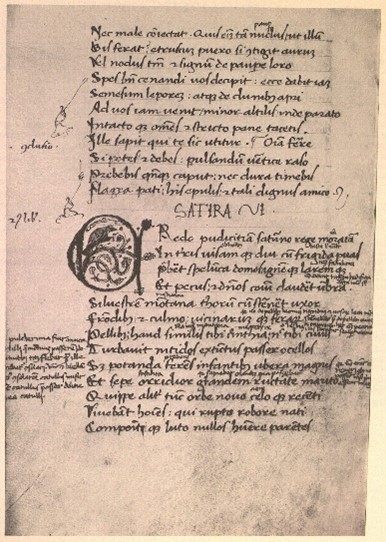
Decimus Iunius Iuuenalis, also known as Juvenal, was a Roman satiric poet in the 1st/2nd century CE. Born around 60 CE in Aquinum, a little town near Monte Cassino, Juvenal published the first of his overall five volumes of Satires (see fig. 1) near 110 CE.1
It is not clearly known when, but Juvenal did visit Egypt at some point in his life. Gilbert Highet deduces in his book on Juvenal’s life2 that the satirist did not travel up the Nile out of pleasure or personal interest. He is said to have been exiled to Egypt and either sent to Pentapolis3, to the west of Egypt, or to Hos or Hoasa4, the Great Oases. Juvenal seems to emanate contempt for Egypt whenever he speaks about it.5
Elephants and ivory
Juvenal, although not very descriptive about his journey to and through Egypt, mentions the import of ivory from the “gate of Syene”6:
“But these days, the rich get no pleasure from dining, the turbot and venison have no taste, the fragrances and roses seem rotten, unless the enormous round table top rests on a massive piece of ivory, a rampant snarling leopard made from tusks imported from the gate of Syene and the speedy Moors and from the Indian who is darker still, the tusks dropped by the beast in the Nabataean grove when they’ve become too large and heavy for its head.”7
Syene, and even more so Elephantine as the name suggests, have been related to the ivory trade since Pharaonic times. There were also different trade routes for ivory and elephants during the Ptolemaic dynasty8 but by the time of Juvenal, the Romans probably used import routes via Syene and Elephantine as this excerpt suggests.9
- Highet 1954, 2; 4-5. ↩
- Highet, G., “Juvenal the Satirist. A Study” (London 1954). Online available. ↩
- Malalas Chron. 10.49. ↩
- P scholia 1.1; 4.37; 15.27. ↩
- Highet 1954, 5; Schmidt 2021, 273-4. This dislike of Egypt is closer analyzed by Highet in his chapter about Juvenals Satire Fifteen (Highet 1954, 149-53.) ↩
- Iuv. Sat. 11.124. ↩
- Iuv. Sat. 11.120-127. Translated by S. M. Braund and online available in Loeb. ↩
- Three major import routes during the first three Ptolemies: the Myos Hormos-Koptos route, the route from Nechesia to Apollonopolis Magna and from Berenike to Apollonopolis Magna (Schmidt 2021, 271). ↩
- Schmidt 2021, 271. ↩