Written by Fabio Calo
Biography
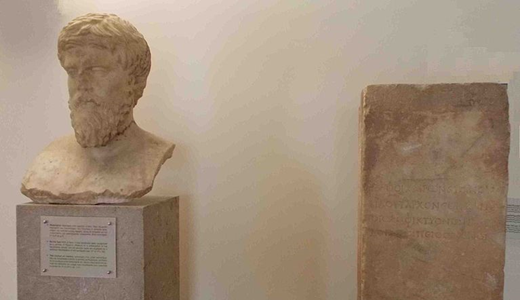
Plutarch was a Greek writer, philosopher and Apollo priest of the turning of the first to the second century CE. He was born ca. 45 CE in the Boeotian city of Chaironeia, where he stemmed from a wealthy family. This afforded him a refined education: He probably received rhetorical training in Athens and also the tuition of the Egyptian Ammonios,1 one of the revered Platonic philosophers of his time. His education not only prepared him for his literary work, but also for a political career: Throughout his life, he held multiple civic offices at his hometown of Chaironeia as well as at nearby Delphi, the most prominent of which is probably the priesthood of the ancient Apollo sanctuary. He also headed several diplomatic envoys to Roman officials, gaining him acquaintance with several influential men of consular rank and, eventually, Roman citizenship.2 Plutarch also undertook several journeys to Italy and Rome, as well as to Alexandria.3
Plutarch is said to have written about 260 works, which can be roughly divided into biographical and historiographic writings on the one hand and philosophical writings on the other. His most famous work are the Parallel Lives of Greek and Roman historical figures. The Moralia is a modern collection of 78 philosophical treatises and dialogues by Plutarch (not all of them authentic) and one by another author.4 It is there that one can find several scattered references to Syene/Aswan.
Plutarch about Syene
Wether Plutarch was ever in Syene or in the area of the First Cataract is unknown. He was once in Alexandria,5 but there is no information on how long he stayed and if he visited other Egyptian cities.6 Opinions differ on the value of his information about local history and customs. While Babbitt attests in his introduction to De Iside et Osiride that „Plutarch’s knowledge of Egyptology was not profound,”7 Richter cites a tradition of scholars who believed that “Plutarch, despite his inability to read hieroglyphics or to converse with non-Alexandrian natives, was a good religious historian.”8 His sources for the ancient Egyptian religious costums included the works of Herodotus and Diodorus, in addition to the priests of the Egyptian cults.9 Babbit suspects the existence of one or more works about ancient Egyptian culture and history that were used by Plutarch and other authors in antiquity, but are lost to us today.10
In his treatise On Isis and Osiris (De Iside et Osiride), Plutarch writes about the Egyptians’ differing habits of eating or not-eating fish:
Ἰχθύων δὲ θαλαττίων πάντες μὲν οὐ πάντων ἀλλʼ ἐνίων ἀπέχονται […]. Συηνῖται δὲ φάγρου· δοκεῖ γὰρ ἐπιόντι τῷ Νείλῳ συνεπιφαίνεσθαι, καὶ τὴν αὔξησιν ἀσμένοις φράζειν αὐτάγγελος ὁρώμενος.
“As for sea-fish, all Egyptians do not abstain from all of them, but from some kinds only […]. The people of Syenê abstain from the phagrus; for this fish is reputed to appear with the oncoming of the Nile, and to be a self-sent messenger, which, when it is seen, declares to a glad people the rise of the river.”11
Exactly which fish was meant by the phagrus from which the Syenites abstained is by no means certain. It could be the elongate tigerfish (Hydrocynus forskahlii), as suggested in the Cambridge World History of Food.12 In the Loeb edition of De Iside et Osiride, Babitt identifies this fish with the sea bream,13 in the Tusculum edition, Görgemanns suggests the mullet.14 Brier and Bennett cautiously hypothezised that it might be the Bagrus bayad.15 The abstention of the Syenites from this sacred fish was later also described by Aelian;16 Herodotus had mentioned the consumption of fish in general as a religious taboo for all Egyptian priests,17 an information that is confirmed by Plutarch.18 In this passage, Plutarch wants his reader, who is adressed by the dedicatee Clea, to understand the real reasons behind the foreign customs and religious rites of the Egyptians and also to dispel some common misconceptions about them. In this case, the Syenites abstain from the phagrus because the appearance of this particular fish signals to them the approach of the annual Nile flood, making it an idispensable herald of nature and the gods. Plutarch’s underlying goal in De Iside et Osiride, however, is to create an understanding of ancient Egyptian religion through Greek paideia and (Platonic) philosophy, thereby appropriating Egyptian religion for his Greek-reading audience.19
In the dialogue The Obsolescense of Oracles (De defectu oraculorum), the attendants discuss the question of wether far-reaching conclusions can be drawn from small samples of data. Kleombrotos of Sparta had told his company the story of a priest he had met at the shrine of Ammon, who told him that his lamp would need noticably less oil year after year. Kleombrotos took this as evidence for the theory that the years would successively shorten. This idea is immediately refuted by the other guests. Ammonios, Plutarch’s old teacher, counters Kleombrotos’ argument:
ἔτι δὲ τοὺς μὲν ἐν Συήνῃ γνώμονας ἀσκίους μηκέτι φαίνεσθαι περὶ τροπὰς θερινὰς πολλοὺς δὲ ὑποδεδραμηκέναι τῶν ἀπλανῶν ἀστέρων, ἐνίους δὲ ψαύειν καὶ συγκεχύσθαι πρὸς ἀλλήλους, τοῦ διαστήματος ἐκλελοιπότος.
“Moreover, the phenomenon observed at Syenê, where the upright rods on the sun-dials cast no shadow at the time of the summer solstice, is bound to be a thing of the past; many of the fixed stars must have gone below the horizon, and some of them must be touching one another, or have become coalescent, as the space separating them has disappeared!”20
Syene lies (roughly) below the Northern Tropic, so that once a year, at the midsummer solstice, it could be observed that upright bodies in Syene cast no shadows. This had already been described by the geographer Strabo21 around 24 BCE and by the poet Lucan22 around 65 CE.23 It may not be a coincidence that Plutarch attributes this line to Ammonios, since as a native of Alexandria (see above), his Egyptian background would lend validity to the information about Syene.
In Plutarch’s dialogue Concerning the Face Which Appears in the Orb of the Moon (De facie in orbe lunae), he mentions Syene as representative of a certain hot and dry climate. The subject of discussion is the question of wether the moon could possibly be inhabited. Lamprias, Plutarch’s brother, adresses Theon, an Egyptian, who had just argued that due to the complete lack of rain and monthly recurring summer periods, life was not possible there.24 Lamprias counters that argument by pointing out that there are also climate zones on our earth where there is little or no rain and where the local flora has adapted to those conditions:
ὕλην δὲ καὶ καρποὺς αὐτοῦ μὲν ὄμβροι τρέφουσιν, ἑτέρωθι δὲ ὥσπερ ἄνω περὶ Θήβας παρ᾿ ὑμῖν καὶ Συήνην οὐκ ὄμβριον ὕδωρ ἀλλὰ γηγενὲς ἡ γῆ πίνουσα καὶ χρωμένη πνεύμασι καὶ δρόσοις οὐκ ἂν ἐθελήσειεν, οἶμαι, τῇ πλεῖστον ὑομένῃ πολυκαρπίᾳ συμφέρεσθαι δι᾿ ἀρετήν τινα καὶ κρᾶσιν. τὰ δ᾿ αὐτὰ φυτὰ τῷ γένει παρ᾿ ἡμῖν μὲν ἐὰν σφόδρα πιεσθῇ χειμῶσιν ἐκφέρει πολὺν καὶ καλὸν καρπὸν ἐν δὲ Λιβύῃ καὶ παρ᾿ ὑμῖν ἐν Αἰγύπτῳ δύσριγα κομιδῇ καὶ δειλὰ πρὸς χειμῶνάς ἐστι.
“The fruits of tree and field here in our region are nourished by rains; but elsewhere, as up in your home around Thebes and Syene, the land drinking water that springs from earth instead of rain-water and enjoying breezes and dews would refuse, I think, to adapt itself to the fruitfulness that attends the most abundant rainfall, and that because of a certain excellence and temperament that it has. Plants of the same kind, which in our region if sharply nipped by winter bear good fruit in abundance, in Libya and in your home in Egypt are very sensitive to cold and afraid of winter.”25
Here, Cherniss and Helmbold in the Loeb edition make a connection of Plutarch’s statement to Theophrastus, who had stated that in Egypt, Babylon and Bactria, plants were watered by dew rather than by rain.26 The statement that in Egypt, all water floods not by rain from above, but by underground springs (οὐκ ὄμβριον ὕδωρ ἀλλὰ γηγενὲς) may have come from Plato’s Timaios, as Cherniss and Helmbold in the Loeb edition propose.27
- See Ziegler 1951, 651-3; Baltes, Lakmann 1996; Lakmann 2017, 43-9. He features several times in Plutarch’s writings: He is a participant in the Symposiacs, as well as in the dialogues On the epsilon at Delphi and On the Obsolescence of Oracles. Another work of Plutarch dedicated to Ammonios is now lost (Ziegler 1951, 652; Lakmann 2017, 43). In Plutarch’s writing, Ammonios is portrayed rather amiable; the high regard the former pupil held for his tutor becomes apparent there (see Baltes, Lakmann 1996, 600; Lakmann 2017, 44). ↩
- His Roman name was Mestrius Plutarchus, so it appears that he was granted citizenship by L. Mestrius Florus (cos. suff. ca. 75 CE), one of Plutarch’s Roman friends who is a frequent participant in Plutarch’s Quaestiones Conviviales (see Pelling et al. 2000, 1159-60). Reports about Roman honorary titles (such as a procuratorship of the province Achaea 119 CE) are somewhat dubious (see Pelling et al. 2000, 1160). ↩
- For the biographical data see Ziegler 1951, 639-41; Pelling et al. 2000, 1159-60; 1165-6; Titchener, Zadorojnyi 2023, 3-6. For information about Plutarch’s family background in particular see Ziegler 1951, 641-51; 653-7 for his travelling; 657-9 for his political offices; 659-62 for his priesthood. ↩
- See Pelling et al. 2000, 1166. ↩
- See Plut. Mor. 678C. ↩
- See Babbit 1936, 3; Ziegler 1951, 654. ↩
- Babbit 1936, 3. ↩
- Richter 2001, 192. ↩
- See Babbit 1936, 3-4. ↩
- See Babbit 1936, 4. ↩
- Plut. Mor. 353C-D (transl. Babbitt). Note the version in Görgemann’s Tusculum edition, which reads instead Ἰχθύων δὲ θαλαττίων πάντες μὲν πάντων, τῶν δ’ἄλλων οὐ πάντων, ἄλλ’ ἐνίων ἀπέχονται (“Alle Fische aus dem Meer werden von allen gemieden; von den übrigen Fischen nicht alle, sondern nur einige”). The insertion of πάντων, τῶν δ’ἄλλων is, in fact, an emandation by the editor, not found in any of the manuscripts. The reason for this is perhaps to eliminate a logical problem that occurs when Plutarch introduces the subject of the Egyption’s consumption of sea fish (the adjective θαλάττιος clearly designating maritime fish) and then gives as example only such species that are to be found in the Nile. The second Teubner edition from 1971 reads the same line as the Loeb edition. It should, in any event, be born in mind that the tradition of this work of Plutarch is particularly problematic and has led to some emandations of the manuscripts by modern editors: see for this Babbit (ed.) 1936, 5; Görgemanns (ed.) 2009, 285. To decide, which version is to prefer in this instance, this article is not the proper place. ↩
- See Grivetti 2000, 1498. ↩
- See Babbit 1936, 19. ↩
- See Görgemanns 2009, 145 with n. 7.1 (explained on p. 384). ↩
- See Brier, Bennett 1979. ↩
- See Ael. NA X 19. ↩
- See Hdt. II 37. The line between the religious obligations that are to be observed by the priests in particular and those that apply also to the ‘common man’ is somewhat blurred in this passage. In context, it seems more likely that he is in fact talking about the priests only. ↩
- See Plut. Mor. 353D: οἱ δ᾿ ἱερεῖς ἀπέχονται πάντων (“The priests, however, abstain from all fish,” transl. Babbitt). ↩
- See Plut. Mor. 351E-F; 355C-D; Pelling et al. (2000) 1172; Richter (2001), 193-4; 202-3; 206-7 and passim; Manolaraki (2013), 253; 256; 257. ↩
- Plut. Mor. 411A-B (transl. Babbitt). ↩
- See Str. XVII 1,48. ↩
- See Luc. II 586-7. ↩
- Lucan poetically amplifies the phenomenon to a permanent state. It would later be explained by Macrobius (Macrob. In Somn. II 7,15-6), correcting Lucan’s exaggeration, and by Ammianus Marcellinus (Amm. XXII 15,31). ↩
- See Plut. Mor. 938A-C. ↩
- Plut. Mor. 939C-D (transl. Cherniss, Helmbold). ↩
- See Theophr. Hist. pl. VIII 6,6; Cherniss, Helmbold (eds.) 1957, 171 n. b. ↩
- See Cherniss, Helmbold (eds.) 1957, 171 n. b; cf. Pl. Ti. 22E. ↩