Written by Julia Schulz
Biography
The clergyman Rev. Greville John Chester was born on October 25, 1830, in Norfolk. He is known for his numerous donations of ancient artefacts to the British Museum, the Ashmolean Museum, and other institutions which he collected during his numerous journeys around the globe.1
He started travelling after he had retired from his parish in Sheffield in 1865. In poor health for a long time, he decided to spend more time in warmer regions. Chester’s first travels were to Italy, Egypt and North Africa, hereafter he spent two years in the West Indies and Americas. He frequently returned to Italy, Malta, Egypt and the Levant, particularly to Palestine and Syria, in the following years, but his favored place was Cairo as it was a popular spot for antiquities and manuscripts trade.2
Chester was a member in associations like the Royal Archaeological Institute3 and the Oxford Union debate society and carried out expeditions for the Palestine Exploration Fund.4
Relations with Other Archaeologists
Chester was acquainted with the Cairo-born Italian Egyptologist Rodolfo Vittorio Lanzone who was a collector of Arabic manuscripts and Egyptian antiquities, too, and presumably assisted Chester in some of his acquisitions.5 But Chester also helped others in buying antiquities, for instance, the Amateur Egyptologist and member of the Egypt Exploration Fund Anne Goodison with whom he used to travel together.6 Chester maintained a close relationship with the British Assyriologist Archibald Henry Sayce with whom he examined Greek inscriptions in Gebel el-Silsila between January and February of 1890.7
In his publication Seventy Years in Archaeology Flinders Petrie mentionsJohn Greville Chester and his part as a “notable figure in Egyptian matters”. Petrie and Chester were friends and used to travel together till the death of the latter in 1892.8
Chester and the British Museums
Most Chester’s artifacts were gifted to the Bodleian Library, the Oxford colleges and the Ashmolean Museum as well as the British Museum. Other objects he sold to institutions and collectors in order to finance his travels.9
His donations solely to the Ashmolean Museum amount to thousands of objects which is the reason why, a room in the Egyptian Galleries had been named after him.10 Donated objects exhibited in the Egyptian Rooms include pottery, textile fragments and part of a painted diptych which was procured from “Christian Coptic sources”.11 Additionally, from 387 Hellenistic and Greek engraved gems hosted by the Ashmolean Museum 151 gems have a Chester provenance.12 Regarding the British Museum it can be stated that Chester’s donations made a decisive contribution to the growth of the museum’s papyri collection, especially to the Byzantine period texts since his donations include many Greek fragments from the 5th and 6th century which were discovered in the Fayyum.13
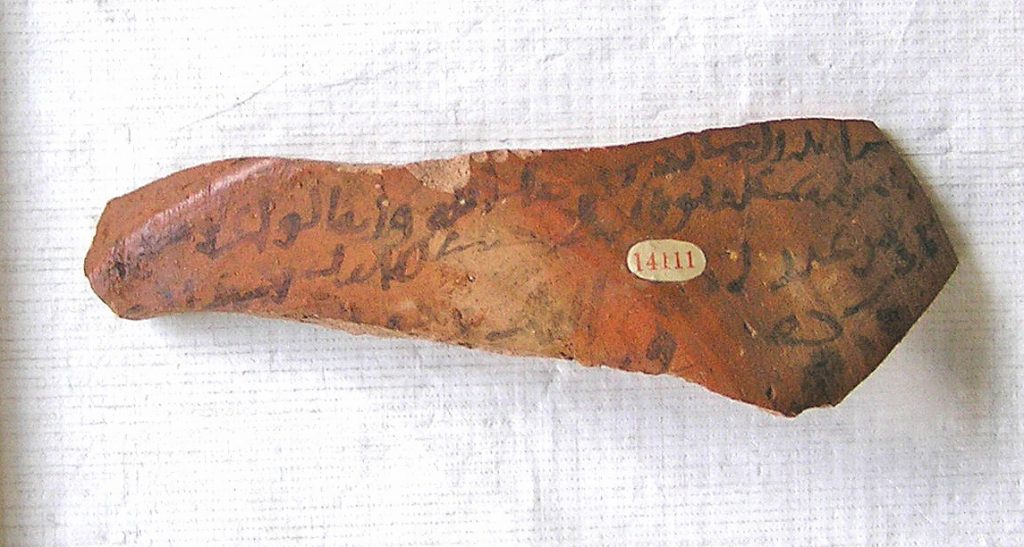
© The Trustees of the British Museum.
The database of the British Museum indicates that 1207 objects were donated by and further 6887 bought from Chester.14 There are 107 entries with an Aswan/Syene provenance, for the major part Coptic ostraca, Roman terracotta fragments, lamps and vessels all dating from the Graeco-Roman and Coptic periods.15 The ostraca were most likely bought at Elephantine including one ostracon (see fig. 1) acquired in 1876 with Arabic stemming from the time after the Arab conquest of Egypt in 639-642.16
Chester continuously worked for the improvement of the museum and its collections and even took over the task to catalogue all Egyptian Antiquities hosted by the Ashmolean Museum between 1878 and 1879.17
- Seidmann 2006, 27-28. ↩
- Seidmann 2006, 29. Cairo seems to be the starting point for Chester’s visits to Egypt and also the place where he met other traders and made a lot of acquisitions for the museums (Jefferson 2019, 276; 278). ↩
- Chester was a member since his first undergraduate year of college. He loaned them objects from his personal collection and published articles in their Journal, see AJ iv, 1847-xlix, 1892 (Seidmann 2006, 29). ↩
- Seidmann 2006, 29-30. ↩
- Jefferson 2019, 278. ↩
- Jefferson 2019, 281. There was an exhibition at the Atkinson Art Gallery and Library from January 2, 2018 – March 10, 2018 displaying Goodison’s acquisitions. For more information see: <Adventures in Egypt – Mrs Goodison & Other Travellers – The AtkinsonThe Atkinson> (Accessed 25.07.2021). ↩
- Jefferson 2019, 277. Gebel el-Silsila was a sandstone-quarry located ca. 18km north of Kom Ombo (Klemm; Klemm 1993, 242). Since some of the objects from the British Museum’s database with Aswan/Syene provenance were acquired by him the same year as this trip it may be possible that he bought them at that time. ↩
- Petrie 1931, 22. ↩
- Seidmann 2006, 30. ↩
- The so-called “Chester Room“ contains majorly small objects which were preferably acquired by Chester himself (Seidmann 2006, 30). ↩
- Seidmann 2006, 31. Seidmann does not specifiy Chester’s source further. ↩
- Seidmann 2006, 30. ↩
- Aside from Greek papyri Chester also bought the earliest Hebrew manuscripts from the Cairo Genizah and donated them to the Bodleian Library (Jefferson 2019, 271; Seidmann 2006, 30.). ↩
- Jefferson 2019, 271. ↩
- For an overview of objects acquired by Chester with Aswan/Syene provenance in the British Museum see: <Collection search | British Museum> (Accessed 23.07.2021). ↩
- For more information on the ostracon (EA14111) see: <https://www.britishmuseum.org/collection/object/Y_EA14111> (Accessed 23.07.2021). ↩
- Seidmann 2006, 31. See Chester, G. J., Catalogue of the Egyptian Antiquities in the Ashmolean Museum. Oxford: Parker & Co (1881). ↩